The challenge
Here is the contractor's paradox. The best time to get a new lead is while you are busy, because busy means the phone and the ads are working. It is also the worst time to answer one, because you are on a roof, under a sink, or in an attic. The lead from Angi, Yelp, or a Google ad does not wait. It fills out the next company's form, and the next company answers first.
Most contractors know this and have tried the usual fixes: an office manager who is also doing payroll, an answering service that takes messages nobody returns until evening, a CRM that sends a cheerful auto-reply nobody reads. None of them answers the lead in a minute and keeps at it until something is on the calendar.
What we built
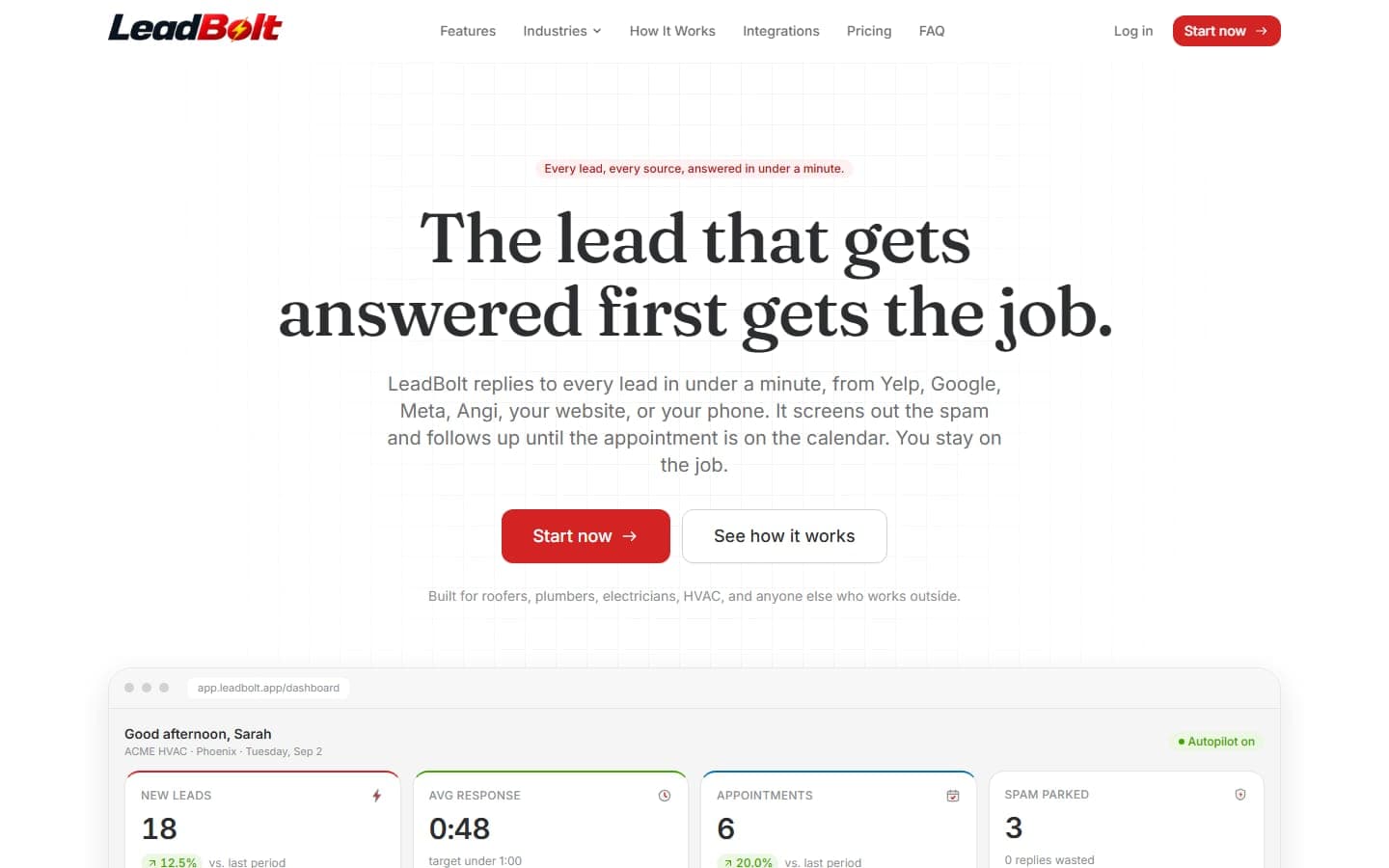
LeadBolt is a software product, not a brochure. It answers every Yelp, Google, Meta, Angi, website, and phone lead in under a minute, screens out the spam, and follows up until the appointment is on the calendar. The roofer on the job still wins the lead that came in while they were on the roof.
That is a SaaS product: accounts, a dashboard, connections to outside lead sources, and logic that decides who gets a reply and what it says. It sits closer to a web application than to a website, and it was built that way, with integrations at the center rather than the edges.
The marketing site carries the same discipline:
- One promise on the first screen. "The lead that gets answered first gets the job." Everything else on the page supports that sentence.
- The live dashboard, shown rather than described. Visitors see new leads, response times, appointments, and parked spam in the product's own interface, not in a paragraph of adjectives.
- Pricing published. No "contact sales for a quote" for a product built to save contractors time.
- A start button on every page. Whenever the visitor is convinced, the next step is right there.
Why it works
Speed is the product. A lead that hears back in under a minute is talking to you while the need is fresh. A lead that hears back in two hours has already talked to someone else. LeadBolt's whole job is closing that gap automatically, which is a form of marketing automation that a contractor can actually feel.
Spam screening protects attention. Every junk lead a contractor answers is time stolen from a real one. Filtering it out before anyone replies keeps the follow-up aimed at people who might book.
Follow-up until booked. Plenty of people do not answer the first reply. They are at work, in the car, or comparing notes with a spouse. Software does not get tired of asking politely, and it keeps asking until the appointment is on the calendar.
The site sells the way the product works. Contractors are skeptical buyers with good reason. Showing the dashboard, publishing the price, and putting a start button on every page treats them like adults. Our conversion optimization work follows the same principle: remove the reasons to hesitate, and the decision tends to make itself.
What's on the site
- A first-screen promise about answering first
- The live dashboard shown in the product's own interface
- Lead sources named plainly: Yelp, Google, Meta, Angi, website, and phone
- Published pricing
- A start button on every page
LeadBolt is built for the same contractors whose websites we build: roofers, plumbers, electricians, and home services companies of every kind. If you have a software idea of your own, our custom SaaS development page explains how we approach it. For the website side of the same customer, see the American Roofing case study and the Bleuwave Home Services case study, and for the math on paid leads, try the ROAS calculator.